
What are the Similarities and Differences between Cognitive Behavioral Therapy and Mindfulness-Based Therapy?
If you are considering therapy, you may have come across Cognitive behavioral therapy (CBT) and Mindfulness-based therapy. Both approaches can help people understand and change their relationship to difficult thoughts, emotions, and behaviors, but they do so in different ways.
So what is the difference between CBT and Mindfulness-based therapy? In simple terms, CBT often focuses on identifying and changing unhelpful thought patterns and behaviors, while mindfulness-based approaches focus on noticing thoughts, emotions, and physical sensations without immediately judging or reacting to them.
The two approaches are not necessarily competing choices. Depending on your needs and goals, a therapist may use elements of both.
What Is Cognitive Behavioral Therapy?
Cognitive behavioral therapy (CBT) is a structured form of talk therapy that focuses on the relationship between thoughts, feelings, and behaviors.
The basic idea is that the way we interpret a situation can influence how we feel and what we do next. CBT helps people recognize patterns that may be making a problem harder to manage and develop more balanced ways of responding.
For example, imagine that you send an important message to someone and do not receive a response. You might immediately think, "They are upset with me" or "I must have done something wrong." That thought could lead to anxiety and cause you to repeatedly check your phone or avoid the person.
In CBT, you might examine the thought, consider the available evidence, identify other possible explanations, and choose a more balanced response.
CBT can be used for a range of concerns, including anxiety, depression, trauma-related difficulties, and some addictive or compulsive behaviors. The specific techniques used depend on the person's concerns and treatment goals.
What Is Mindfulness-Based Therapy?
Mindfulness-based therapy incorporates mindfulness skills into psychotherapy. Mindfulness generally means paying attention to what is happening in the present moment with greater awareness and less judgment.
Instead of immediately trying to change an uncomfortable thought, mindfulness teaches you to notice it.
For example, instead of thinking, "I am an anxious person," you might learn to recognize, "I am noticing anxiety right now."
That small shift can create space between an experience and your reaction to it.
Mindfulness-based therapy may involve practices such as mindful breathing, body awareness, tracking your thoughts and emotions, and learning to respond rather than automatically react.
One important distinction is that Mindfulness-based therapy is a broad category. One specific approach is Mindfulness-Based Cognitive Therapy (MBCT), which combines mindfulness practices with cognitive behavioral concepts. Research comparing MBCT and traditional CBT has found both approaches can reduce symptoms of depression, although the evidence base and appropriate use depend on the specific condition and treatment context.
How Are CBT and Mindfulness-Based Therapy Similar?
Although CBT and Mindfulness-based therapy use different strategies, they share several important features.
Both can increase self-awareness
Both approaches help you become more aware of what is happening internally.
CBT may ask you to examine:
What happened?
What did I think?
How did that thought affect my feelings?
What did I do next?
Mindfulness may ask you to notice:
What am I experiencing right now?
What thoughts are coming up?
What sensations do I notice in my body?
Am I reacting automatically?
Both approaches can help you to slow down and recognize patterns that might otherwise happen automatically.
Both teach practical skills
Neither approach encourages talking about problems without learning anything new.
CBT may teach cognitive restructuring, behavioral strategies, problem-solving, or other skills.
Mindfulness-based approaches may teach observing your thought and behavioral patterns, present-moment and body awareness, and ways to tolerate difficult experiences without immediately reacting to them.
The goal is to develop skills that can be practiced in everyday life, outside of the therapy session.
Both can address anxiety and emotional distress
CBT is widely used for depression and anxiety-related concerns, while mindfulness-based approaches may also be incorporated into treatment for anxiety, stress, depression, and other concerns.
The best approach depends on the person's symptoms, goals, preferences, and clinical needs.
What Is the Difference Between CBT and Mindfulness-Based Therapy?
The biggest difference is how each approach relates to thoughts and emotions.
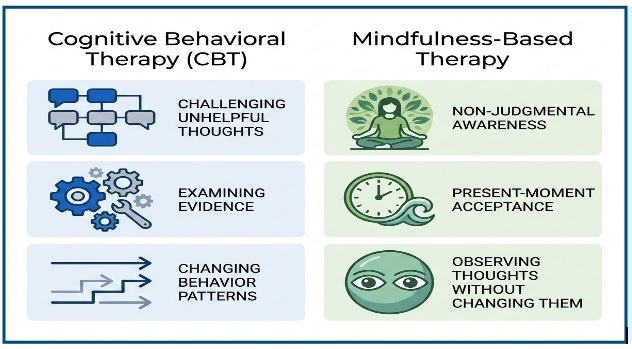
| Cognitive Behavioral Therapy | Mindfulness-Based Therapy |
|---|---|
| Often examines and challenges unhelpful thoughts | Often focuses on observing thoughts without immediately changing them |
| Emphasizes the connection between thoughts, feelings, and behaviors | Emphasizes present-moment awareness and acceptance |
| May use structured cognitive and behavioral exercises | May include mindfulness, breathing, and body-awareness practices |
| Often focuses on changing patterns that contribute to distress | Often focuses on changing how a person relates to difficult experiences |
| Can be highly goal- and problem-focused | May place greater emphasis on awareness and non-reactivity |
These are general differences rather than strict rules. Therapists may combine techniques from different approaches depending on what is clinically appropriate.
CBT vs. Mindfulness: How Do They Handle Difficult Thoughts?
This is one of the clearest ways to understand the difference.
Suppose you are thinking:
"I am going to fail."
A CBT approach might explore the thought by asking:
What evidence supports this thought?
What evidence does not support it?
Am I assuming the worst?
Is there another way to interpret the situation?
What would be a more balanced thought?
Mindfulness takes a different route.
Instead of debating whether the thought is true, you may practice noticing:
"I’m aware of thinking that I am going to fail."
You observe the thought as a mental event rather than automatically treating it as a fact.
Research describing the distinction between CBT and Mindfulness-based cognitive therapy similarly notes that CBT emphasizes restructuring thoughts, while mindfulness can emphasize changing one's relationship with thoughts and recognizing them as experiences rather than facts.
Neither approach requires you to simply "think positively." The goal is to develop a healthier and more flexible response to what is happening.
CBT for Anxiety vs. Mindfulness-Based Therapy for Anxiety
Both CBT and mindfulness-based approaches may be considered when anxiety is affecting daily life.
CBT for anxiety often focuses on identifying anxious predictions, understanding avoidance behaviors, and practicing different ways of responding to feared or stressful situations.
For example, someone who constantly worries that something bad will happen may learn to identify patterns of catastrophic thinking and develop more balanced responses.
Mindfulness-based therapy for anxiety may focus more on noticing anxious thoughts and physical sensations without immediately attempting to suppress, escape, or react to them.
For some people, these approaches can complement each other. A therapist may help someone examine an unhelpful thought while also practicing mindfulness to notice the anxiety that comes with it.
CBT for Trauma vs. Mindfulness-Based Trauma Therapy
Trauma treatment should be individualized. Not every mindfulness exercise or CBT technique is appropriate for every person with a trauma history.
CBT-based trauma approaches may address trauma-related thoughts, emotional responses, avoidance, and behaviors. Some trauma-focused CBT approaches are specifically designed to address the effects of traumatic experiences.
Mindfulness may be used as part of treatment to help someone notice present-moment sensations and emotions and develop greater awareness of their responses.
However, mindfulness should not be presented as a substitute for specialized trauma treatment. If trauma symptoms are significantly affecting daily life, a qualified therapist can help determine which treatment approach is appropriate.
CBT for Addiction and Mindfulness-Based Addiction Therapy
CBT and mindfulness can also be used in work involving substance use or other addictive behaviors, but they approach the problem differently.
CBT for addiction may help a person identify triggers, recognize thought and behavior patterns, develop coping strategies, and plan for situations that may increase the risk of returning to an unwanted behavior.
Mindfulness-based approaches may help a person become more aware of cravings, emotions, physical sensations, and urges without automatically acting on them.
For example, rather than immediately responding to a craving, mindfulness may involve noticing where the urge appears in the body and observing how it changes over time.
Treatment for addiction should be individualized and may involve multiple forms of professional support.
CBT Therapy for Couples vs. Mindfulness in Couples Therapy
CBT principles can also be applied in couples therapy.
CBT-based couples work may focus on communication patterns, assumptions about a partner, conflict behaviors, and expectations within the relationship.
For example, one partner might interpret a tense response as "They are irritated at me," while the other partner may simply be distracted or overwhelmed. Examining these interpretations can help couples understand how thoughts influence emotional reactions and communication.
Mindfulness in couples therapy can encourage partners to slow down, listen more intentionally, notice emotional reactions, and become more aware of what is happening during difficult conversations.
In some cases, mindfulness and CBT strategies can work together: a couple may learn to notice an emotional reaction before responding and then examine the thoughts contributing to the conflict.
Can CBT and Mindfulness Be Used Together?
Yes. CBT and mindfulness can be used together, and some therapeutic approaches specifically combine cognitive behavioral principles with mindfulness practices. Here at Easefull Counseling, we use these two modalities interchangeably as needed.
Mindfulness can help a person notice thoughts and emotions before reacting to them, while CBT can provide tools for examining thought patterns and changing behaviors. Mindfulness-Based Cognitive Therapy is one example of an approach that brings these ideas together.
The combination does not mean that everyone needs both approaches. A therapist can help determine which strategies fit the person's concerns, preferences, and treatment goals.
Is CBT Better Than Mindfulness-Based Therapy?
There is no universal answer to whether CBT is "better."
The more useful questions are: Which approach is appropriate for your particular needs and goals? Which approach is more easily integrated into your daily life and style of thinking?
Someone looking for structured strategies to address specific thought and behavior patterns may prefer CBT. Someone interested in developing present-moment awareness and changing their relationship with difficult thoughts may connect more with mindfulness-based therapy.
Sometimes the answer is not one or the other. An integrative treatment plan may incorporate techniques from both.
A research study comparing CBT and MBCT for major depressive disorder found significant symptom reductions in both treatment groups, with the study concluding that MBCT appeared as effective as CBT for current depression in that sample. This does not mean the therapies are interchangeable for every condition or individual, but it illustrates why treatment decisions should be based on the specific clinical situation rather than assuming one approach is always superior.
How Do You Know Which Approach May Be Right for You?
Choosing between CBT and mindfulness-based therapy is not something you need to figure out alone.
Consider what you want from therapy. You may prefer a structured, skills-focused approach if you want to work directly on specific thought and behavior patterns. You may prefer mindfulness-based work if you are interested in developing awareness of thoughts, emotions, and physical sensations without immediately reacting to them.
Your therapist can also consider the nature of the concern, your treatment history, your comfort with mindfulness practices, and your goals.
If you are looking for therapy in Boca Raton, Florida, or prefer the flexibility of online therapy, discussing these options with a qualified therapist can help you make a more informed decision.
Frequently Asked Questions
What is the difference between CBT and mindfulness-based therapy?
CBT often focuses on identifying and changing unhelpful thoughts and behaviors. Mindfulness-based therapy focuses more on present-moment awareness and observing thoughts, emotions, and sensations without immediately judging or reacting to them. Some approaches, such as MBCT, combine elements of both.
Is CBT better than mindfulness therapy for anxiety?
Neither approach is automatically better for everyone. CBT is commonly used to address anxiety-related thought patterns and behaviors, while mindfulness-based strategies may help people become more aware of anxious thoughts and physical sensations without immediately reacting to them. A therapist can help determine which approach best fits your needs.
Can CBT and mindfulness be used together?
Yes. CBT and mindfulness can complement one another. Mindfulness can help someone notice thoughts and emotional reactions, while CBT can provide structured techniques for examining those thoughts and changing behaviors. MBCT is an example of an approach that combines cognitive behavioral and mindfulness principles.
What is mindfulness-based therapy used for?
Mindfulness-based approaches may be incorporated into therapy for concerns such as stress, anxiety, depression, and other forms of emotional distress. The specific approach and evidence vary by condition. Mindfulness may also be used as one component of a broader treatment plan rather than as a standalone treatment.
Can CBT help with trauma?
CBT principles are used in several approaches to trauma treatment, including specialized trauma-focused therapies. Treatment should be tailored to the individual's symptoms, history, and needs. If you have experienced trauma, a therapist can help determine whether a trauma-focused CBT approach or another evidence-informed treatment is appropriate.
Can mindfulness help with addiction?
Mindfulness-based techniques may be incorporated into treatment to help people notice cravings, emotions, physical sensations, and urges without automatically acting on them. However, mindfulness should not be considered a universal replacement for addiction treatment. A comprehensive treatment plan may involve several forms of professional support.
Do I have to choose between CBT and mindfulness?
No. Depending on your situation, therapy may incorporate techniques from both approaches. The choice can depend on your goals, symptoms, preferences, and the therapist's clinical assessment. You can discuss these options with a qualified therapist before deciding what approach may be the best fit.
Final Thoughts
CBT and Mindfulness-based therapy share an important goal: helping people develop greater awareness and more effective ways of responding to difficult experiences.
The main difference is how they approach those experiences. CBT often works by examining and changing unhelpful thinking and behavior patterns, while mindfulness focuses on noticing thoughts and feelings with greater awareness and less automatic reaction.
For some people, one approach may feel like a better fit. For others, combining mindfulness and cognitive behavioral strategies may be useful.
If anxiety, trauma-related symptoms, relationship difficulties, addiction, or ongoing stress are affecting your daily life, speaking with a therapist can help you understand your options and choose an approach that fits your individual needs.
Educational note: This article provides general mental-health information and is not a substitute for individualized professional evaluation or treatment.
A Helpful Next Step
If you are considering therapy in Boca Raton, Florida, or prefer the convenience of online therapy, Easefull Counseling can help you explore your concerns and discuss which therapeutic approach may fit your goals. You do not have to determine the right treatment approach before reaching out. A conversation with a qualified therapist can be a useful place to start.